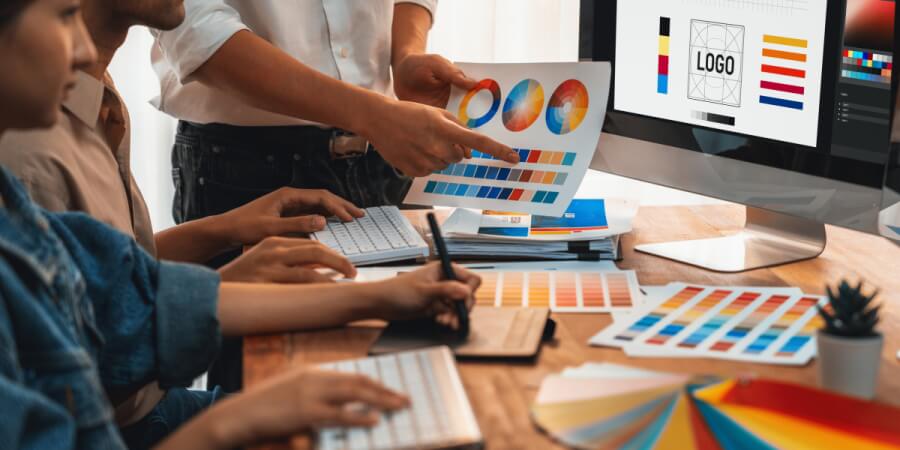
Artificial intelligence (AI) has the power to personalize graphic designs, generate unique visuals, and automate repetitive tasks such as resizing images for web display. It is already transforming how graphic designers work.
Nearly 90% of designers currently use AI in some part of their workflow, according to a 2025 report on the state of AI use in design from Foundation Capital and Designer Fund. However, many designers worry about AI’s potential to eliminate jobs and drain design of its originality. As AI continues to evolve, many designers are considering the ethics of using AI and what its impact is going to be on design careers.
The Impact of AI on Graphic Design
Generative AI draws from datasets it has been trained on to create new content, including visual content. AI image generators like Midjourney and DALL-E 3 can create graphics in a fraction of the time it takes humans to sketch or composite ideas manually. Tools like Adobe Firefly integrate AI into industry-standard software, allowing designers to generate backgrounds, adjust lighting, expand images, or test variations directly within programs they already use.
In practice, AI is reshaping multiple stages of the design workflow. Designers can use AI to quickly prototype concepts, generate mood boards, experiment with layouts, or test color palettes before determining the final direction they want to take. Tasks that once required repetitive manual efforts — such as resizing assets for different platforms or removing backgrounds — can now be automated.
New technologies have transformed creative professions in the past. The rise of digital design tools and photo editing software shifted the process for creating designs. Today, AI is further accelerating that shift by compressing timelines, increasing iteration speeds, and expanding designers’ access to design experimentation.
However, using AI tools raises unique ethical questions that graphic designers are confronting. By understanding both the benefits and challenges of using AI in graphic design, designers can adapt to the changing market for their work.
Resources on AI and Graphic Design
Learn more about how AI is being used in graphic design — and the role of ethics in AI — with the following resources:
- Foundation Capital and Designer Fund, “State of AI in Design”: This report from Foundation Capital and Designer Fund based on a survey of over 400 designers examines how AI is changing the field, with 89% of respondents saying AI has improved their workflow.
- SAP, “What Is AI Ethics?”: SAP outlines the core principles of using AI ethically, emphasizing fairness, privacy, and accountability. This article defines these principles and discusses ways for organizations to implement AI policies.
- International Organization for Standardization, “Building a Responsible AI: How to Manage the AI Ethics Debate”: This resource from the ISO explores how responsible AI aligns technology with societal values and expectations, highlighting strategies for addressing ethical concerns.
- Creative Bloq: “‘It’s a Genie Out of the Bottle’: How AI Is Impacting Graphic Design”: Creative Bloq explores how AI has changed graphic design, and includes predictions that the profession will lose jobs. However, expected growth in the need for user interface (UI) and user experience (UX) designers shows the continued importance of professionals with design skills.
- Design Week, “Most Designers Say AI Improves Their Process, but Ethical Concerns Remain”: Design Week showcases research on AI use in design, sharing data from a survey of designers on their ethical concerns about AI.
Ethical Challenges of Using AI in Graphic Design
Long before generative AI, designers have wrestled with ethical considerations in graphic design. How do graphic designers avoid copyright infringement? When do designs require a disclaimer? How can designers make their work more accessible?
Introducing AI into the design process raises new ethical challenges, including questions about intellectual property, creativity, and ownership.
4 Ethical Questions Regarding AI Use in the Graphic Arts
As AI-generated images flood social media and digital platforms, graphic artists are confronting the ethical challenges that AI presents for their profession.
Experienced visual professionals are leading the conversation. For example, in his exploration of professional ethics for AI-driven design, visual tech expert Paul Melcher examines the challenges, potential pitfalls, and strategies needed to address AI’s ethical concerns directly.
1. Is Using AI a Form of Plagiarism?
While graphic designers often turn to reference designs to spark new ideas, they understand the distinction between inspiration and plagiarism. But AI can blur that boundary.
AI models trained on existing images and designs can generate outputs that closely resemble elements of their training data, leaving designers unaware of their unintentional plagiarism. For example, an AI model built on a library of corporate logos may produce a logo that resembles an existing mark, opening up a designer to legal challenges.
Experienced designers can bring their knowledge of branding and copyright law to their work to reduce the risk of unintentionally plagiarizing someone else’s design. They can also choose AI models built on licensed or public domain training materials.
2. Can AI-Generated Designs Be Original?
Graphic designers and artists present their work as their own creations. However, using AI raises new questions about the creativity and originality of a design. Who is the creator when a designer uses AI tools?
One approach to this ethical question treats AI as a medium. The introduction of photography in the 1800s raised similar questions about whether photographers were artists or technicians.
Designers can prioritize originality by treating AI as a tool rather than a replacement. A creative eye can turn a snapshot into art, and similarly, graphic designers can apply their strategic and aesthetic expertise when refining AI-assisted outputs.
3. How Does Bias Impact AI in Design?
AI models reflect the data used to train them, which can unintentionally be embedded with biases. As a result, AI-generated content may include insensitive or culturally offensive content.
The bias starts in the training process. For example, training datasets may overwhelmingly contain English-language sources or Western visual styles. In addition, AI tools may struggle to understand cultural nuances, further increasing the risk of producing biased designs.
Graphic designers can avoid this pitfall by watching for bias in AI outputs and regularly evaluating them against established inclusivity guidelines.
4. Who Owns AI-Generated Content?
If a graphic designer uses an AI platform to generate images, does the platform retain any rights? What about the creators whose works were used to train the AI model?
These questions remain unresolved and may evolve as legal frameworks develop. For now, the U.S. Copyright Office will not issue copyrights for purely AI-generated works. At the same time, determining how much human involvement is required to claim authorship is being evaluated on a case-by-case basis.
As a result, using AI in their design process may leave designers with more limited legal protections.
Research on the Ethics of Using AI in Graphic Design
Scholarship on the ethics of using AI in graphic design offers guidance for designers seeking direction. Learn more from these recently published scholarly articles:
- Visual Communication Quarterly, “The Reality of Artificial Intelligence in Graphic Design and Its Impact on Designers”: Based on a survey of designers, this study finds that AI techniques are becoming integral to the field and can reduce time and effort. It recommends that educational institutions teach AI techniques.
- Innovations in Publishing, Printing and Multimedia Technologies, “Ethical Dimensions of Artificial Intelligence in Graphic Design: Challenges, Opportunities and the Future of Creative Practice”: In its analysis of the ethical use of AI in graphic design, this article evaluates privacy, transparency, and bias concerns to raise the key ethical considerations for designers.
- Journal of Arts and Humanities, “The Use of Generative Graphics in Graphic Design: Aesthetics and Ethics”: Drawing on case studies and industry reports, this article examines the balance between the aesthetic potential of using AI in graphic design and its ethical implications, arguing that the field needs to prioritize ethical AI use.
- IEEE Computer Graphics and Applications, “Ethical Considerations and Implications of Generative AI in Computer Graphics”: Through its analysis of AI use in computer graphics, this study investigates ethical issues related to authenticity, intellectual property rights, and cultural appropriation.
Ethical Use of AI in Graphic Design
How can graphic designers use AI ethically? Visual artists, designers, and professional associations offer guidance and guidelines.
For example, the Graphic Artists Guild recommends that users “prioritize human voices and processes alongside automated tools.” The organization has also developed guidelines on the ethical use of generative AI:
- Creator rights: Designers should choose AI platforms that license the works used to train their systems and only rely on materials that creators have opted in for use. Similarly, designers should only upload content in the public domain rather than copyrighted sources.
- Privacy: Artists and designers should secure consent from contributors before including their works in AI datasets. They should also advocate for using AI tools that avoid personal or sensitive content.
- Environmental impact: Designers should remain mindful of the environmental costs associated with large-scale AI computing and restrict its usage. This includes using AI as a supplemental tool rather than a default solution.
- Transparency: Designers should clearly label AI-generated or AI-assisted content and disclose their use of AI to their clients. They should also credit sources used in training the AI.
Designers and graphic design organizations may also consider fairness, equity, and legal compliance when developing guidelines for ethical AI use.
Resources From Designers on Using AI Ethically
Experienced designers continue to explore the ethical uses of AI in the design process. Explore their perspectives through the following resources:
- Nicky Borowiec, “AI in Design: Ethics, Challenges, and Where to Draw the Line”: Brand strategy consultant and visual identity designer Nicky Borowiec argues that AI can best replace noncreative, time-consuming tasks. She also emphasizes the importance of transparency in how publishers and designers use AI.
- The Intelligent Designer, “The Ethical AI Designer: Using AI Responsibly in Your Design Practice”: Interior designer and educator Stacy Thorwart explores how designers can use AI responsibly and transparently. The article includes a list of best practices, including continuous learning about AI and ethics.
- Mind Foundry, “Approaching Ethical AI Design: An Insider’s Perspective”: This discussion considers how designers can know whether they’re using AI ethically, noting that standards continue to evolve as AI itself changes.
- Parachute Design, “Exploring the Ethics of AI in Design”: Web designer Jay Eckert examines the ethics of using AI in design, discussing potential solutions and real-world examples. He concludes that while AI can serve as a supplemental design tool, it should not drive the design process.
- Cat Coquillette, “The Ethical Use of AI for Artists and Creative Entrepreneurs”: Artist and designer Cat Coquillette explores how AI can be a helpful tool for artists with the right approach. She suggests avoiding practices like including AI-generated art in portfolios.
Best Practices for Using AI in Graphic Design
AI cannot replace the expertise and creativity of a human graphic designer. However, designers can benefit from AI tools when they use them intentionally. Best practices for using AI in graphic design treat the technology as an assistant or supplement rather than a replacement.
What does that mean in practice? AI can help designers brainstorm, test ideas, accelerate time-consuming steps, and customize designs. Human creativity and expertise, however, should guide the overall process.
AI can contribute to the design process in several ways:
- Visual brainstorming: Designers can use AI to find inspiration, identify reference images, and generate visualizations. Framing AI as a supplement to the visual brainstorming process allows designers to generate concepts during the early stage of a design project.
- Iteration: As in any design process, graphic designers should iterate to test, evaluate, and refine their designs. AI tools can support the iteration process by showing different layouts, color palettes, or textures quickly.
- Automation: Time-intensive tasks like removing backgrounds, resizing, or formatting images can be sped up with AI. Designers can also make their prototyping process more efficient by using AI-assisted templates or wireframes.
- Customization: Graphic designers often use custom color palettes and graphics based on a client’s brand and target customers. AI can speed up the process of customizing designs that once relied on generic stock images or more expensive options.
While AI can offer a starting point, graphic designers can draw on their expertise in design strategy to refine and customize the AI-generated content to make it their own.
Resources on Using AI in Graphic Design
Designers seeking to balance the efficiency benefits of using AI with responsible practice can explore the following resources:
- London Design Company, “AI in Graphic Design: Tools, Ethics and Best Practices”: This article discusses the benefits of using AI from a design agency perspective, particularly its scalability and personalization capabilities. It suggests using AI as a creative partner while outlining best practices for using AI responsibly.
- Meta, “How to Use AI for Design: Use Cases and Best Practices”: Meta recommends methods for designers to use to explore ideas and support their design process with AI. It also suggests that designers use AI to build their knowledge of design tools.
- Tiller Digital, “AI in Design: An Art Director’s Perspective”: Learn about AI pitfalls from an art director’s point of view, including the risk of creating generic design outputs and the loss of the personal touch.
- Ethical Design Co., “11 Ways AI Can Enhance Your Output as a Graphic Designer (Without Replacing Humans)”: This article explores popular AI tools for graphic designers, with a discussion of how to use AI responsibly.
AI for Graphic Designers
Graphic designers can benefit from integrating AI into their process. However, AI alone does not provide the strategic direction or creative judgment that effective design requires.
To work best, AI tools need human guidance. Successful graphic designers rely on their understanding of creative strategy, brand psychology, and design trends to use AI tools thoughtfully and ethically.
Follow Us
Thinking about taking a class this semester? There’s still time to enroll through CSUN’s Open University with no admission process, just opportunity! Open to everyone. Flexible online and in-person.
— CSUN Tseng College (@csun_tseng) August 25, 2025
Enroll today: https://t.co/RYc6LL5ZRO#CSUN #CSUNOpenUniversity #Fall2025 pic.twitter.com/SpEfYgqELK